
“The Constitution is not optional, and today the Virginia Supreme Court proved it still matters. This was an extraordinarily courageous opinion from the Court in a case loaded with political pressure and national implications.” — Ken Cuccinelli, National Chairman, Election Transparency Initiative, and former Virginia Attorney General
FOR IMMEDIATE RELEASE | LINK
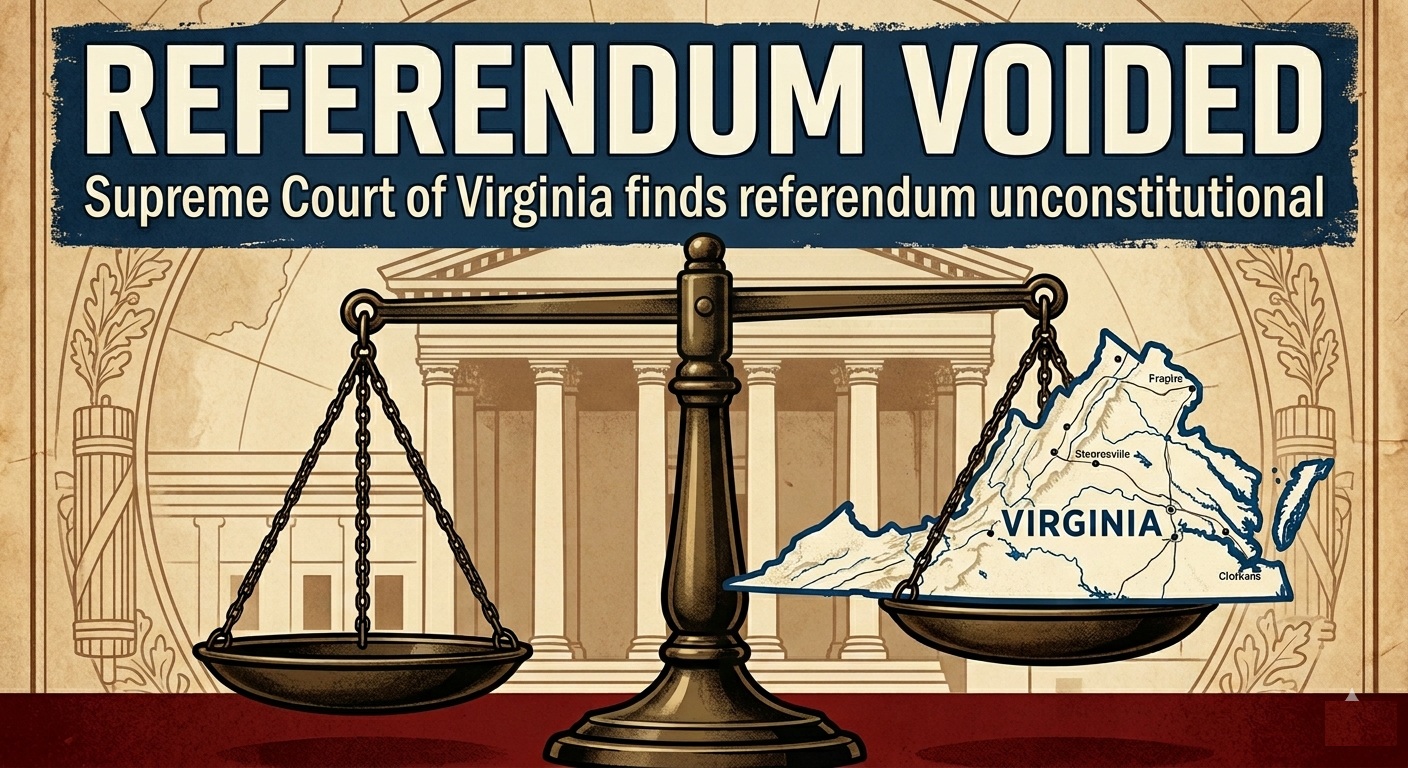
Virginia Supreme Court voids referendum and blocks proposed congressional maps after ruling Virginia Democrats forced localities statewide to conduct an unconstitutional referendum.
Arlington, VA — May 8, 2026 —In a 4-3 decision, the Supreme Court of Virginia struck down Virginia’s redistricting referendum as unconstitutional, voiding the election and blocking implementation of the proposed congressional maps after finding the General Assembly failed to comply with constitutional requirements governing the amendment process.
The Court ruled that the General Assembly violated Article XII, Section 1 of the Virginia Constitution, which requires an intervening election between the legislature’s first and second passage of a proposed constitutional amendment.
Because approximately 1.3 million Virginians had already voted in the 2025 statewide election before lawmakers passed the amendment proposal for the first time on October 31, 2025, the Court determined that election could not constitutionally qualify as the required intervening election. Early voting in Virginia’s 2025 statewide elections had begun on September 19, 2025 — weeks before the General Assembly acted.
Cuccinelli: Virginia Taxpayers Forced to Fund Unconstitutional Referendum
The ruling brings a dramatic end to a rushed and legally flawed referendum effort that forced every Virginia locality to spend taxpayer resources conducting an election the Court ultimately determined was unconstitutional.
“This was not some harmless procedural mistake,” said former Virginia Attorney General Ken Cuccinelli, National Chairman of the Election Transparency Initiative (ETI). “Every locality in Virginia was forced to spend time, manpower, and taxpayer dollars administering an unconstitutional referendum because Virginia Democrats decided constitutional requirements were inconvenient.”
The Court’s opinion follows weeks of rapidly advancing litigation, including expedited review and oral arguments before Virginia’s highest court. Cuccinelli urged Virginians and members of the media to read the Court’s actual opinion carefully.
“It is an exceptionally well-written opinion,” Cuccinelli said. “This was not an ordinary case, and the justices were remarkably candid and courageous in confronting what the General Assembly did here.”
While the majority expressed concern regarding the General Assembly’s use of a special session to advance the amendment, the Court ultimately did not decide that issue because it was unnecessary to the outcome once the referendum itself was found unconstitutional.
The Court likewise did not rely on alleged violations of Virginia’s 90-day notice statute in reaching its decision.
Cuccinelli also expressed disappointment that Virginia Attorney General Jay Jones chose to bring in an outside California attorney to argue the case before Virginia’s highest court rather than relying on experienced constitutional attorneys already serving within Virginia’s own Office of the Attorney General.
“The outcome would have been the same, but I found that decision deeply disappointing,” Cuccinelli said. “Virginia’s Attorney General’s Office has outstanding constitutional lawyers fully capable of arguing matters involving the Virginia Constitution before Virginia’s highest court. When I served as Attorney General, I trusted and respected the attorneys in that office tremendously, particularly on constitutional matters affecting the Commonwealth.”
Cuccinelli also criticized portions of the dissenting opinion, noting that the dissent advanced arguments not raised by either the Commonwealth or any of the attorneys involved in the litigation and attempted to rely on recent statutes to overcome longstanding constitutional requirements dating back more than a century.
Ruling Leaves Existing Congressional Maps in Place
The Court’s ruling leaves Virginia’s current congressional maps in place and is expected to have significant national implications as redistricting battles continue across the country ahead of the 2026 midterm elections.
Key Links
- Virginia Supreme Court opinion:
https://www.vacourts.gov/static/courts/scv/districting/redistricting_final.pdf - Cuccinelli Press Briefing (C-SPAN):
https://www.c-span.org/program/news-conference/former-virginia-ag-ken-cuccinelli-on-va-supreme-court-redistricting-decision/678876
Media Availability
Ken Cuccinelli is available for television, radio, podcast, and print interviews regarding the ruling and its implications nationwide.
Members of the media may submit interview requests at:
https://electiontransparency.org/contact/
To request interviews, please include:
- Outlet
- Media type (TV, radio, digital, phone)
- Host name
- Requested time
About the Election Transparency Initiative
The Election Transparency Initiative (ETI) was established as a partnership between the American Principles Project (APP) and Susan B. Anthony Pro-Life America. ETI works nationwide to advance commonsense election reforms that protect the integrity of the vote and strengthen public trust in election outcomes through policies that enhance transparency, accountability, and confidence in American elections. ETI is chaired by Ken Cuccinelli, who previously served as Acting Deputy Secretary of the U.S. Department of Homeland Security and as Attorney General of Virginia.
###