
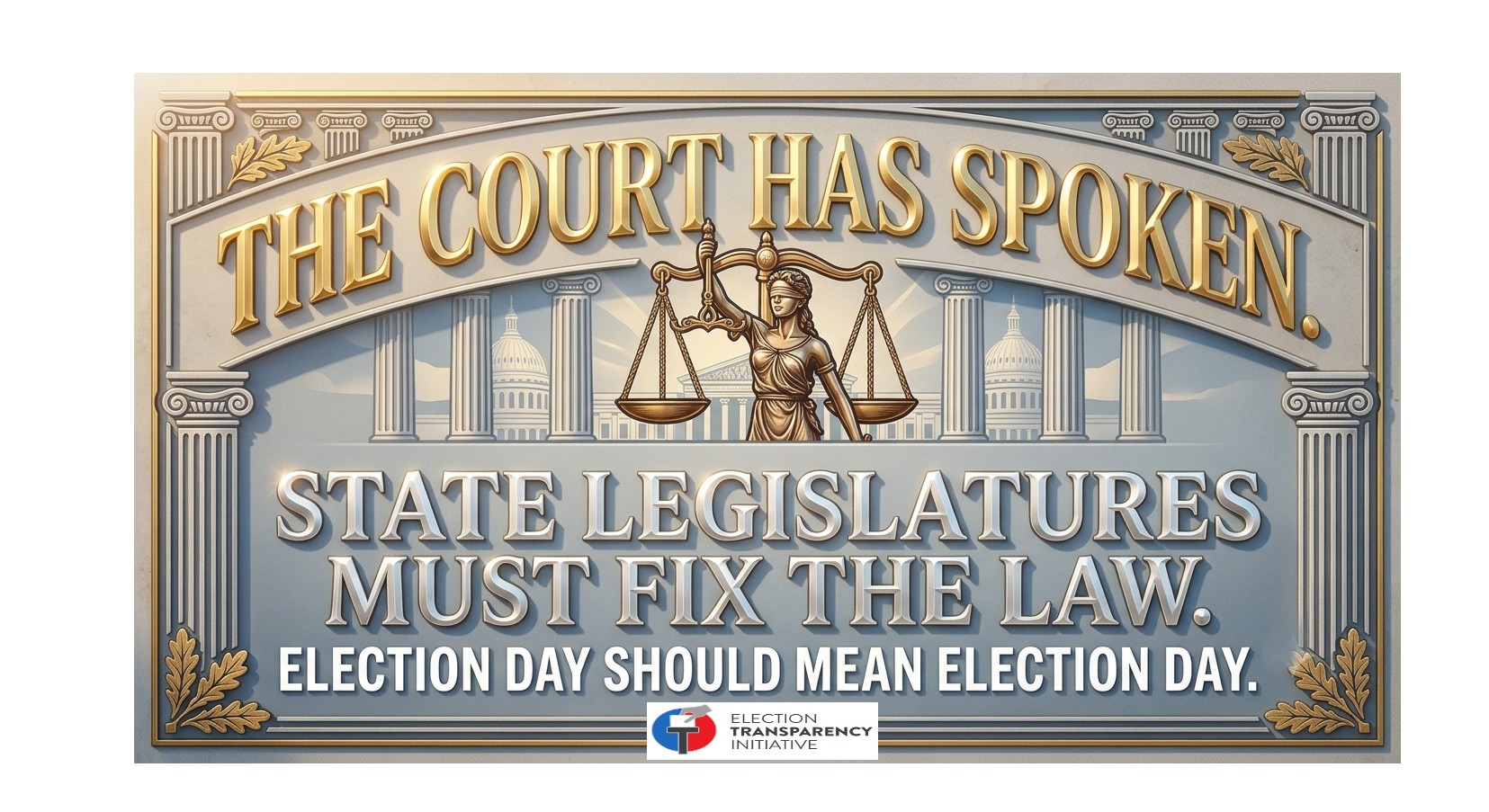
“The Court made clear that judges won’t write election law. Legislators must.”
— Ken Cuccinelli, National Chairman, Election Transparency Initiative
Court acknowledges election fraud, and its appearance are “serious issues,” points to Congress and state legislatures as the proper avenue for reform
FOR IMMEDIATE RELEASE | LINK
Arlington, VA — July 1, 2026 — The Election Transparency Initiative (ETI) today said the U.S. Supreme Court’s decision in Watson v. Republican National Committee should serve as a call to action for Congress and state legislatures to establish clear ballot receipt deadlines if they believe Election Day should truly mean Election Day.
The Court’s opinion held that existing federal election statutes do not require mailed ballots to be received by Election Day, concluding instead that current law establishes when ballots must be cast—not when they must be received.
“From the standpoint of election integrity, requiring all ballots to be received by Election Day remains the gold standard for preventing fraud and strengthening public confidence,” said Ken Cuccinelli, National Chairman of the Election Transparency Initiative. “The Supreme Court did not hold that such a policy would be unconstitutional. It held only that Congress has not enacted that requirement in current federal law. That means lawmakers—not judges—must decide whether to establish a uniform national ballot receipt deadline.”
Writing for the majority, Justice Amy Coney Barrett acknowledged that “Election fraud and its appearance are serious issues” but concluded that “they must be addressed through the democratic process.” She further explained that if different ballot receipt deadlines warrant a national solution, “the American people must choose it through their elected representatives.” Barrett emphasized that while the Court could not add language Congress never enacted, concerns regarding election integrity and public confidence remain legitimate policy questions for lawmakers to address.
The Court also pointed to history, noting that Congress previously established a uniform national Election Day after differing state election dates created allegations of fraud. If varying ballot receipt deadlines now warrant a national standard, the Court explained, “the American people must choose it through their elected representatives.”
“Justice Barrett’s opinion provides a clear roadmap,” Cuccinelli continued. “Congress solved one election integrity problem by creating a uniform Election Day. If lawmakers believe ballots should be received by Election Day, the Court has made clear that Congress has the authority to enact that policy. Likewise, states remain free to adopt Election Day receipt requirements under their own laws.”
Cuccinelli also noted that the Court’s decision provides an important clarification by reaffirming that ballots must be cast by Election Day under federal law, even though they may be received later if state law permits.
“Unfortunately, some states, like California, have adopted election procedures that can leave the public questioning whether ballots are effectively being cast after Election Day,” Cuccinelli said. “The Court’s opinion makes clear that federal law requires ballots to be cast by Election Day. That clarification is an important safeguard, even as lawmakers continue working to ensure ballots are also received by Election Day.”
ETI said the ruling reinforces an important constitutional principle: courts interpret statutes as written, while legislatures are responsible for writing election laws that reflect the will of the people.
“The Court has settled the legal question. Now legislators must settle the policy question,” Cuccinelli concluded. “State lawmakers should stop waiting for courts to solve problems they have the authority to fix. They should require that ballots be received by the close of the polls on Election Day, strengthen chain-of-custody protections for absentee ballots, improve ballot tracking and verification, and eliminate procedures that unnecessarily delay election results or undermine public confidence. Election integrity is achieved through good laws, and this decision makes clear that writing those laws is the responsibility of elected legislators—not judges.”
Media Availability
Ken Cuccinelli is available for television, radio, podcast, and print interviews regarding this and other election related issues.
Members of the media may submit interview requests at:
https://electiontransparency.org/contact/
To request interviews, please include:
- Outlet
- Media type (TV, radio, digital, phone)
- Host name
- Requested time
About the Election Transparency Initiative
The Election Transparency Initiative (ETI) was established as a partnership between the American Principles Project (APP) and Susan B. Anthony Pro-Life America. ETI works nationwide to advance commonsense election reforms that protect the integrity of the vote and strengthen public trust in election outcomes through policies that enhance transparency, accountability, and confidence in American elections. ETI is chaired by Ken Cuccinelli, who previously served as Acting Deputy Secretary of the U.S. Department of Homeland Security and as Attorney General of Virginia.
###