
FOR IMMEDIATE RELEASE | LINK
Virginia Supreme Court Did Not “Overturn Democracy” — It Stopped an Unconstitutional Election
“Virginia’s highest court did not create this constitutional crisis. The Democrat-controlled General Assembly created it when it chose politics over the rights of Virginians and the plain text of Virginia’s Constitution.” — Ken Cuccinelli, National Chairman, Election Transparency Initiative; former Attorney General of Virginia
Arlington, VA — May 19, 2026 —Following criticism from Governor Abigail Spanberger and other Virginia Democrats regarding the Supreme Court of Virginia’s ruling striking down the Commonwealth’s redistricting referendum as unconstitutional, former Virginia Attorney General Ken Cuccinelli said the Court’s decision should be understood for what it actually was: the correction of an unconstitutional process that violated Virginia law from the beginning.
“This was not the Court ‘overturning democracy,’” Cuccinelli said. “This was the Court preventing an unconstitutional referendum from permanently altering Virginia’s Constitution and congressional maps. This decision protects the constitutional rights of all Virginians, regardless of political party.”
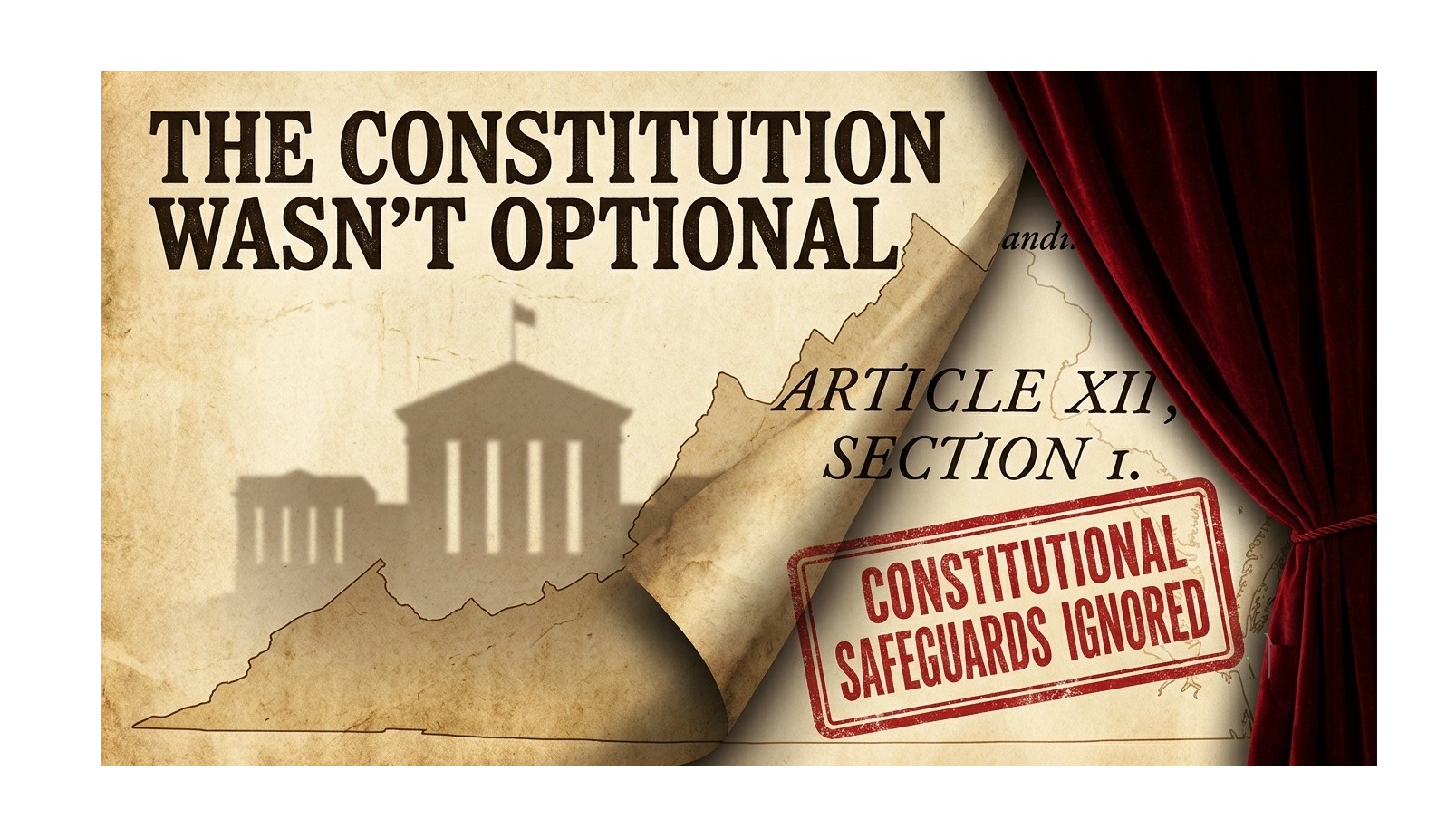
The Virginia Supreme Court ruled 4-3 that the Democrat-controlled General Assembly violated Article XII, Section 1 of the Virginia Constitution by advancing the constitutional amendment process after early voting had already begun in Virginia’s 2025 statewide elections.
The dispute ultimately centered on the constitutional meaning and purpose of Virginia’s intervening-election requirement in an era of widespread early voting. The Virginia Constitution requires an intervening election so voters can judge lawmakers’ actions on a proposed amendment before it advances further.
The Court found that approximately 1.3 million Virginians — roughly 40% of all voters who participated in the election — had already cast ballots before lawmakers passed the amendment proposal for the first time on October 31, 2025.
The intervening-election requirement exists for a reason: to give Virginians the opportunity to respond to legislators’ actions on a proposed constitutional amendment before the process moves forward. Once early voting was already underway, that constitutional safeguard could no longer function as intended. Those voters were therefore denied the constitutionally required opportunity to evaluate the proposed amendment when selecting members of the House of Delegates.
During oral arguments before the Virginia Supreme Court, one of the very first questions directed to the Commonwealth’s attorney went directly to the heart of the case: whether the outcome of the referendum itself had any bearing on the constitutional question before the Court. The Commonwealth’s answer was unequivocal: no. The exchange underscored what the Court ultimately confirmed in its ruling — that the case was not about whether one side won or lost an election, but whether Virginia’s Constitution had been followed in the first place. Notably, this was the same Attorney General’s office that argued before the election that the Court should not rule prior to the referendum itself.
“What Democrats in Richmond are asking Virginians to accept is the idea that constitutional safeguards should simply be ignored if their preferred political outcome is popular enough,” Cuccinelli said. “That is not the rule of law.”
Cuccinelli said the criticism directed at the Court reflects a broader willingness among some Virginia Democrats to subordinate constitutional requirements to political objectives.
“The rule of law means following the Constitution even when it is inconvenient politically,” Cuccinelli said. “Virginia’s highest court did not create this crisis. The Democrat-controlled General Assembly created it when it chose politics over the plain text of Virginia’s Constitution.”
Cuccinelli also criticized subsequent discussions among some Democrats about restructuring the Virginia Supreme Court after the ruling, including proposals to lower the mandatory retirement age for justices in a manner that could remove sitting members of the Court, which would include Chief Justice Cleo E. Powell, the first Black woman to serve on the Supreme Court of Virginia.
“As a former member of the Virginia Senate, I can say unequivocally that retaliating against judges because you dislike a constitutional ruling is unconscionable,” Cuccinelli said. “That is the kind of conduct that undermines public confidence in an independent judiciary.”
The case presented fundamentally state constitutional questions with very limited prospects for emergency intervention by the U.S. Supreme Court. Nevertheless, Attorney General Jones’ office insisted on pursuing the appeal. As former AG Cuccinelli predicted, the U.S. Supreme Court subsequently declined emergency relief sought by Virginia Democrats and the Commonwealth, leaving intact the Virginia Supreme Court’s constitutional ruling.
“Even the U.S. Supreme Court declined to breathe new life into the long-dead referendum,” Cuccinelli said. “The Attorney General’s office had to know this was fundamentally a Virginia constitutional dispute with very limited prospects for emergency intervention at the U.S. Supreme Court. At some point, the litigation appeared aimed less at prevailing legally and more at creating a political narrative around the Court itself.”
The ruling leaves Virginia’s current bipartisan court-drawn congressional maps in place for the 2026 election cycle.
Key Links
- SCOTUS Order
- Virginia Supreme Court opinion
- SCOTUSblog coverage of the emergency appeal
- Cuccinelli post-decision press briefing carried in full by C-SPAN
Media Availability
Ken Cuccinelli is available for television, radio, podcast, and print interviews regarding the ruling and its implications nationwide.
Members of the media may submit interview requests at:
https://electiontransparency.org/contact/
To request interviews, please include:
- Outlet
- Media type (TV, radio, digital, phone)
- Host name
- Requested time
About the Election Transparency Initiative
ETI works nationwide to advance commonsense election reforms that protect the integrity of the vote and strengthen public trust in election outcomes by enhancing transparency, accountability, and confidence in American elections. Ken Cuccinelli serves as National Chairman of ETI. He previously served as Acting Deputy Secretary of the U.S. Department of Homeland Security and as Attorney General of Virginia.
###